
Wednesday, April 28, 2010

Wednesday, April 21, 2010
Family of Man
After perusing my Family of Man magazine (I recently found a copy of the original magazine from the 1950's at a book sale) I found countless images that I absolutely loved. This one image in particular really left a big impression on me:
 Jerry Cooke, Life
 Jerry Cooke, Life
I feel so much emotion coming through in this photograph taken by Jerry Cooke. The girl in the photo looks completely heartbroken and alone. The compostion is exquisite and also adds to the feeling of lonliness that comes across in the photograph- the girl sits near the bottom of the frame while the vast black wall fills up most of the photograph.
Monday, April 19, 2010
Photography in the Atomic Age
 Wynn Bullock, Child in Forest, 1961
This is a very striking image. I love how the stark white body of the child is placed in the foreground amidst the dark, shadowy landscape that stretches out behind the figure of the child. The light in this photo seems to hit in just the right spots, making the photo have an overall magical and surreal feel to it.
Monday, April 12, 2010
Photojournalism as Art
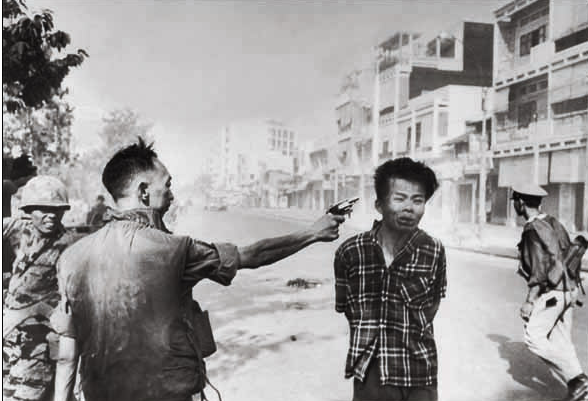 Eddie Adams, Saigon, 1968
This photograph taken by Eddie Adams during the Vietnam War is perhaps one of the most famous photographs of all time. This photograph was taken from a photojournalist's perspective, but it is also recognized for its artistic photographic qualities. The heart-wrenching emotion captured in this photograph is undeniable; one knows that in a single moment this Vietnamese man will be shot dead. Due to its superior photographic qualities, this photo became an iconic image of the Vietnam War.
Friday, April 9, 2010
Nabbing Time
 Harold Edgerton
During the 20th century, faster shutter speeds made it possible for photographer to capture moments they had never captured before. Photographers could now photograph split seconds in time and an entirely different world of photography opened up. The above photo was taken by Harold Edgerton. Edgerton experimented with this notion of a split second in time, and he even took that idea a step further by taking photos of occurrences that happen so quickly that the human eye can't even see them. In the above photo, a bullet has just been shot through an apple that is actually resting atop another bullet. Surely the bullet holding up the apple would have fallen down after this photo was snapped. The photography of Harold Edgerton is a perfect example of how photographers of the 20th century began to take photos that "nabbed" time.
Wednesday, April 7, 2010
Social Documents
 E. J. Bellocq, Storyville Portraits: Untitled, 1912
In the beginning of the twentieth century, photographers began using photography as a method of documenting the filthy conditions that some people lived in as well as some of the hardships they had to go through. The living conditions of American immigrants was a popular subject, and some of these photos were used as "social documents" and used as evidence in various courts around the nation. In the The above photograph is part of a series by E. J. Bellocq. Bellocq wanted to showcase the lives of prostitutes in New Orleans and the terrible conditions they lived in. In the above photo, the prostitute is depicted in a dingy hotel room. She is wearing a mask, which I believes makes the woman a more universal figure.
Monday, April 5, 2010
Eugene Atget
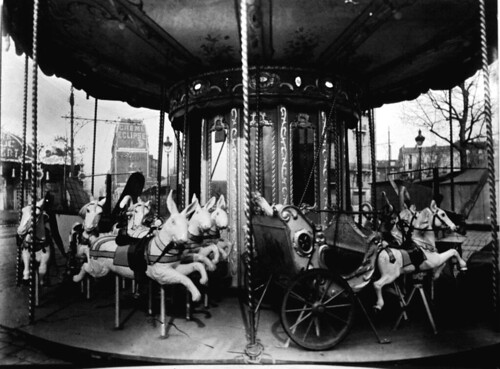 Eugene Atget
Above is a photo that I took in downtown Macon a couple of years ago. This photograph is something that I believe Eugene Atget would definitely approve of. First of all, the photo has urban subject matter, which Atget delved plentifully in. Also, the alley feels completely deserted and as that eeriness to it that so many Atget photographs have. The fact that the alley seems to stretch backwards nearly infinitely only makes it seem more surreal and eerie.
Friday, April 2, 2010
Cliche Verre
 Fredrick Marsh, Homage to Frederick Summer, 2000
Wednesday, March 31, 2010
Cyanotype Project
 photo by Camela Gonzales
I plan on using photos that I have already taken, such as photos of downtown Macon and photos of Rose Hill Cemetery.
Monday, March 29, 2010
Collage
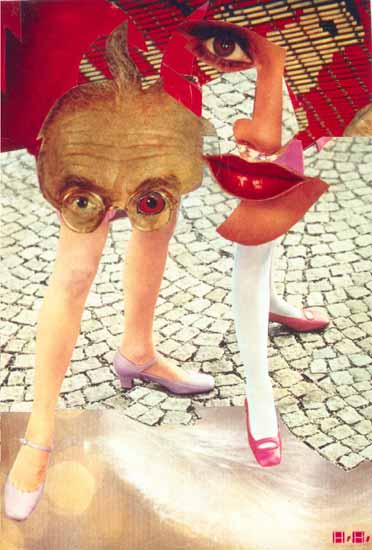 Hannah Hoch
I'm not sure what Hannah Hoch was trying to say with this collage, but I find the image pretty striking and hilarious. It also has an undoubtedly surreal quality to it- cut outs of heads are randomly placed atop the legs of two different women. This collage is bizarre, and I find the bizarre very intriguing.
Friday, March 26, 2010
Man With a Movie Camera
 Dziga Vertov, Man with a Movie Camera, 1929
I chose this still from Man with a Movie camera because it exhibits one of the first uses of the split screen. In the film, many other new techniques are explored, such as stop motion animation. This split screen still also is a good shot of street life in Russia- it gives the audience a glimpse of what life in Russia was like at the end of the 1920's.
Wednesday, March 24, 2010
A Trip to the Moon
 Georges Méliès, A Trip to the Moon, 1902
I really love George Méliès's film, A Trip to the Moon. I love all of the trick photography throughout the film, and I also love how hilarious the actual film is. Before viewing this film, I really did not expect it to be so full of humor. The film still of the moon above displays this humor- the moon has an actual human faces imposed on it, and it is also hilarious that the space shuttle in the film has landed right on his eye.
Monday, March 22, 2010
Lumiere Film
Arrival of a Train at La Ciotat, Lumière Brothers, 1895
This Lumiere film of the train arriving at the station is my favorite. I like how the platform in the station in nearly completely deserted in the beginning. When the train arrives, the film gets more and more entertaining as people start boarding and getting off of the train. What also makes this film is interesting is that it gives us a glimpse of what everyday life was life at the turn of the century. This film lets us see one of America's great technological achievements, the train, in action.
Friday, March 19, 2010
My Cubist Creation: Apple

This is my own Cubist creation that I composed in Photoshop. I took photos of an apple from various angles, and then I used the overlay tool and arranged that apple shots into a pleasing compostion. I'm pretty happy with the way it turned out.
Wednesday, March 17, 2010
Photography and Modernism
 George Braque, Woman with a Guitar, 1913
I think that it's wonderful how photography inspired the art movement of Cubism. Photography allowed artists to see everyday objects in an entirely different light, so it was really only a matter of time until photography seeped into the lives of artists, and, in particular, the painters of the twentieth century. For the movement of Cubsim, photography allowed artists to see ordinary things from severe\al different angles, thus artists began to portray these depictions of different viewing in their painings (such as the Braque painting displayed above). It's interesting how photography inspired painting in the early 1900's when just in the late 1800's painting inspired photography during the movement of pictorialism.
Monday, March 15, 2010
Pictorialism: Women Photographers
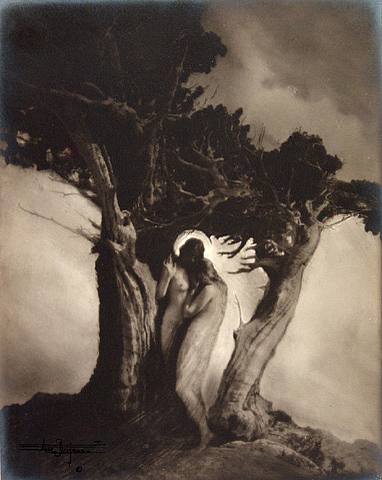 Anne W. Brigman, The Heart of the Storm, 1912, silver print
The Heart of the Storm is an incredibly visually striking photograph. The image is definitely very painterly- one can barely tell that this is a photograph upon first glance. This photo fits in perfectly with the pictorialist movement; it looks so much like a painting that it almost appears as if it contains brush strokes. This image is very powerful. Two figures are embracing one another in the midst of a storm. I'm not quite sure what the intended subject matter here is, but when I look at this photo I feel a great sense of sorrow. However, I also feel a hint of hope. These two figure are caught in the heart of the storm, yet they still have eachother to cling to, and that is where the hope comes in. I wonder how Brigman captured this image, because this is just such a stunning shot and even today this image would be a difficult moment to capture.
Wednesday, March 3, 2010
Pictorialism and Naturalism
 George Seeley, Black Bowl, 1907
I think that this photograph created by George Seeley perfectly embodies the pictorialism and naturalism movements in photography. The pictorialists sought to create photos that resembles the paintings of the time, and this photo has a very painterly feel to it. The image is blurred, giving it a very ethereal quality. This photograph also relates to the movement of naturalism; the woman in the painting is very naturally posed and seems ordinarily human. The light source for the photograph also seems very naturalistic. There is no artificial light, just the natural light coming from one source.
Monday, March 1, 2010
Technological Breakthroughs at the Turn of the Century

Alfonse Van Besten, Modesty, 1912, autochrome

Kinetoscope, invented by Thomas Edison in 1888
The kinetoscope and the autochrome represent two technological innovations that really changed the way people thought in the late 1800's. The autochrome was the first successful colored photograph. With the invention of the autochrome, people were able to see the images they shot in color for the first time, thus opening up the entire world of color to photographers.
The Kinetoscope, invented by Thomas Edison in 1888, was a the first widely marketed machine used to view motion pictures. The films played when someone peered into the Kinetoscope were only one and a half minutes long, but they had a great effect on the viewer. Because of the invention of the Kinetoscope, the masses were able to view their world in motion.
The Kinetoscope, invented by Thomas Edison in 1888, was a the first widely marketed machine used to view motion pictures. The films played when someone peered into the Kinetoscope were only one and a half minutes long, but they had a great effect on the viewer. Because of the invention of the Kinetoscope, the masses were able to view their world in motion.
Friday, February 26, 2010
Eadweard Muybridge
 Eadweard Muybridge, Jumping; over boy's back (leap-frog), 18884-1847
This set of images by Eadweard Mubridge depicts a one boy jumping over the others back. I find this really interesting, because first of all, I think this feat of leap frogging while standing is pretty incredible. Also, it's funny how the boy who is being jumped over seems completely emotionless and unaware that someone is jumping over his head. It's very interesting to see the various position that the jumping boy's body is in; not only his body in the air, but also the position of his body prior to the jump. His body, when frozen in time, appears to be leaning slightly backwards before he jumps, which is odd.
Wednesday, February 24, 2010
Charles Baudelaire
At a photography convention in 1859, Charles Baudelaire famously said "Let [photography] rescue from oblivion those tumbling ruins, those books, prints and manuscripts which time is devouring, precious things whose form is dissolving and which demand a place in the archives of our memory - it will be thanked and applauded.But if it is allowed to encroach upon the domain of the... imaginary, upon anything whose value depends solely upon the addition of something of a man's soul, then it will be so much the worse for us."
Although Baudelaire did not approve of photography as a whole, I believe he would have approved of this image:
Although Baudelaire did not approve of photography as a whole, I believe he would have approved of this image:

This is simply a photographic image of a kidney viewed under a microscope. I think that Baudelaire would definitely approve of this image because he was all for photography used as an aid for science rather than photography being used as a form of art.
Subscribe to:
Posts (Atom)